
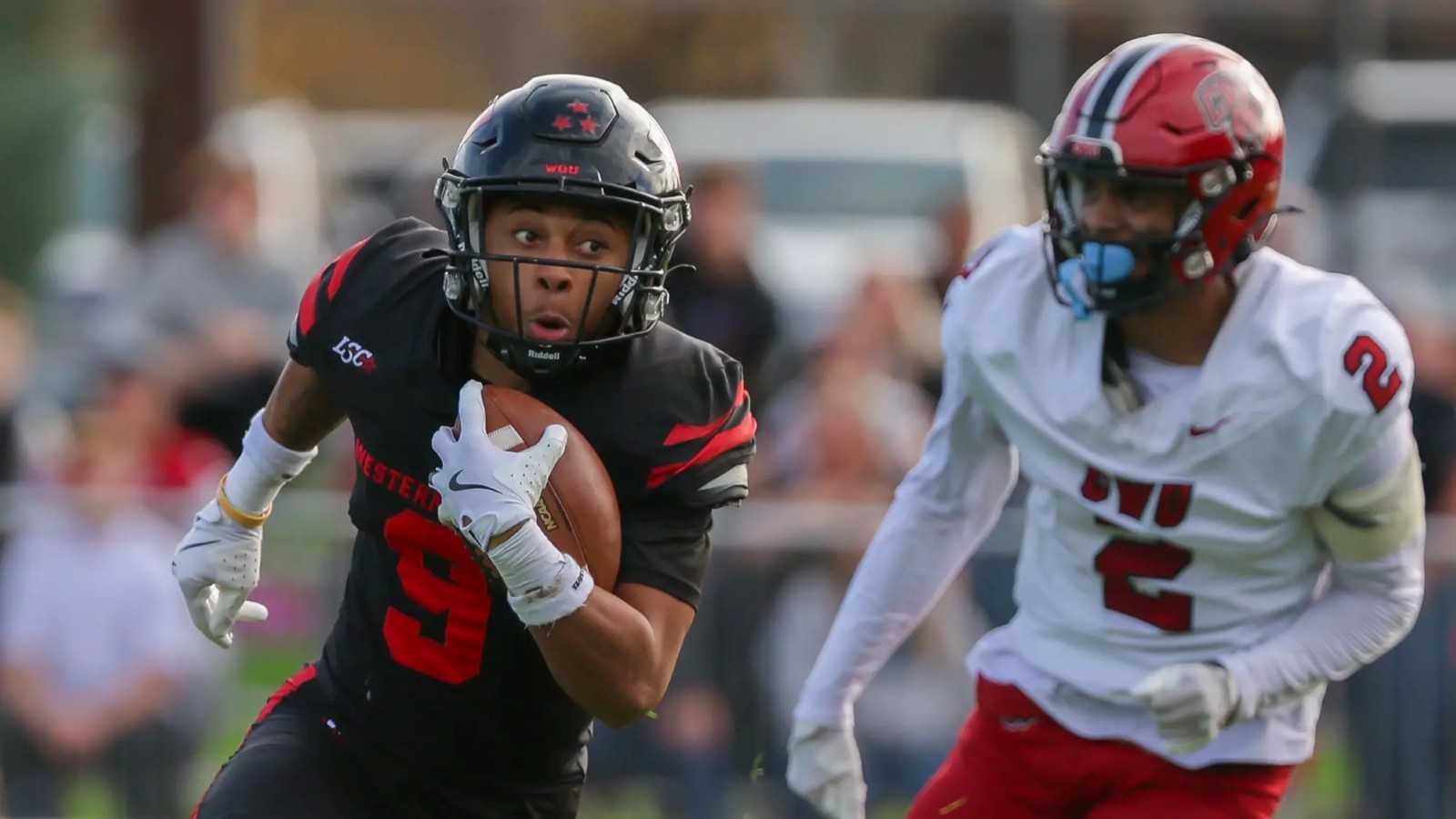
In November 2021, three schools from the NCAA Division 2 Great Northwest Athletic Conference (GNAC) accepted a football-only affiliate membership into the Lone Star Conference. It marked the second time the GNAC stopped sponsoring football since the conference’s inception in 2001. The GNAC originally sponsored football from 2001 through 2005, but dropped the sport following numerous departures. The second attempt lasted longer, spanning 2008 through 2021, but the same core issue remained: a dearth of football teams in the Pacific Northwest in Division 2.
The list of programs to ever play in the GNAC is relatively short: Azusa Pacific, Central Washington, Dixie State (now Utah Tech), Humboldt State, Simon Fraser, South Dakota Mines, Western Oregon, and Western Washington. In fact, the GNAC had so few teams in most seasons that they could play a double round-robin schedule. Unfortunately, that meant any departures dealt a huge blow to the conference’s football hopes. Below is a table showing the GNAC’s football members starting with the first year in 2001 through the 2021 season.
| School | Years in GNAC | Current Status |
|---|---|---|
| Azusa Pacific | 2012 – 2019 | Dropped football after 2020 season; Restarting program for 2026 season in D3 SCIAC |
| Central Washington | 2001 – 2005 2008 – 2021 | Joined Lone Star as affiliate in 2022 |
| Humbold State | 2001 – 2005 2008 – 2018 | Dropped football after 2018 season |
| Simon Fraser | 2010 – 2021 | Joined Lone Star as affiliate in 2022; Dropped football after 2022 season |
| South Dakota Mines | 2014 – 2015 | Joined RMAC in 2016 |
| Utah Tech (fka Dixie State) | 2008 – 2015 | Joined RMAC in 2016; Joined FCS in 2020 |
| Western Oregon | 2001 – 2005 2008 – 2021 | Joined Lone Star as affiliate in 2022 |
| Western Washington | 2001 – 2005 2008 | Dropped football after 2008 season |
To underscore how difficult it is to maintain a program in the Pacific Northwest at the D2 level, consider that 4 of the 8 schools that competed in the GNAC eventually dropped football. Azusa Pacific is bringing back its program, but while in the GNAC, it was playing well outside its Southern California geographic footprint. That’s not an indictment of the GNAC; that’s the reality of the economics for football schools that want to remain in D2 but play in a region where there are simply not many teams. Take a look at the Wikipedia image of NCAA D2 football programs to get an idea of just how remote Central Washington and Western Oregon are from the rest of the division.
A Geographically Unlikely Alliance and Realignment
In 2019, the GNAC and Lone Star Conference announced a scheduling alliance to provide non-conference football matchups to its members. It was slated to begin with the 2020 season… a season that was adversely impacted by the COVID-19 pandemic. Even before the 2020 season began, the two conferences agreed to extend the alliance through the 2023 season. Azusa Pacific was slated to take part in the scheduling alliance for all four years, but the school ended up dropping football in December 2020 without playing a down that season. (APU is bringing back football for the 2026 season, but will play NCAA Division 3’s SCIAC). At this point, the writing was on the wall with only three GNAC football teams remaining and the decision was made for Central Washington, Simon Fraser, and Western Oregon to join the Lone Star Conference as football affiliates beginning in 2022.
Happily ever after, right? Well, not quite. The original agreement between the three GNAC schools and the LSC was for two years. After the 2022 season, the LSC decided not to renew Simon Fraser’s affiliate membership beyond the 2023 season. Simon Fraser announced the news on February 1, 2023, but that was not the end of the bad news. Two months later, on April 4, the school decided to drop football with immediate effect. This led to a public statement from Central Washington to affirm the school’s commitment to football. Repeated attempts to bring back football at SFU have failed and the school is now planning to leave the NCAA altogether to return to U Sports.
In September 2025, Texas A&M-Texarkana announced it would join the Lone Star Conference beginning with the 2027-28 academic year and also add a football team. In February 2026, Texas Wesleyan announced it would leave the NAIA and join NCAA Division 2 beginning with the 2028-29 academic year. The school didn’t state which conference it would join, but the school’s statement made it clear it wanted to be around more Texas schools, which is code for the Lone Star Conference. Cory Hogue reported that those additions are leading to Central Washington and Western Oregon not having their football affiliate agreement extended by the Lone Star Conference. CWU and WOU will be homeless in football beginning with the 2028-29 academic year, as it stands right now.
Alternatives for Central Washington and Western Oregon?
That leads us on a more speculative journey for this section, but some of these scenarios are likely running through the minds of the folks at Central Washington and Western Oregon. There are several possibilities, but none that are particularly convenient for either school. The options are to move to Division 1, remain in Division 2 with football as an affiliate of a different conference, remain in D2 with football as an independent, remain in D2 but drop football, or drop to D3/NAIA.
For D1, the Big Sky Conference is the obvious option, but then you have to be willing to spend the money to compete at the D1 level. Both schools would also need an invitation from the Big Sky, which has 11 full members and 13 football members lined up for the 2026-27 academic year. There’s also the small matter of the new D1 school moratorium, which is in place until February 2027, but could be extended. I’m not sure a move to D1 makes little sense unless it was already in the works, because how many schools would spend an additional $5-$10 million annually just to save maybe hundreds of thousands in travel?
Central Washington had its athletics budget cut to $5 million for 2026, which is down $2 million from previous years. Western Oregon has a budget of $6 million for 2026. Those are the total athletic budgets for the D2 schools. Compare that to a certain Pacific Northwest Big Sky member in Eastern Washington, which is often highly scrutinized by its own institutional staff for needing to make athletic budget cuts. EWU’s football budget is $6 million, and its overall athletics budget is $18 million.
Would a move to D3 be possible if the logical landing spot is the Northwest Conference, which is made up of private institutions? This arrangement seems unlikely, although it can’t be discounted if the schools feel that football must remain part of the athletics program. The NAIA’s Frontier Conference is the only logical conference for either Central Washington or Eastern Washington (or both) to leave the NCAA. There’s also the truly pie-in-the-sky possibility that CWU and WOU somehow convince other schools to start or bring back football to help ease their travel burden. Good luck with that one. Of course, logical outcomes aren’t guaranteed when it comes to realignment.
That makes remaining in D2 the most likely outcome, but becoming an affiliate of another conference isn’t ideal. There are only two options outside the LSC: the Northern Sun Intercollegiate Conference (NSIC) and the Rocky Mountain Athletic Conference (RMAC). Those two are the closest geographically, but both already have at least 10 football-playing members. Is either conference looking to move to 12 teams and have a regular season schedule made up of only conference games? It’s not unheard of at the D2 level, as the Great American Conference already has the same arrangement. Both the NSIC and RMAC would also need to provide Central Washington and/or Western Oregon an invite as well.
When the GNAC stopped sponsoring football for the 2006 and 2007 seasons, Central Washington was an affiliate of the now-defunct North Central Conference, which has a similar geographical layout as the NSIC. CWU went 6-5 in its first season in the NCC, followed by a 10-3 record in 2007, in which they reached the D2 quarterfinals. Western Oregon competed as an independent in both 2006 and 2007 with a mixture of D2, D3, and NAIA schools in both seasons. The Wolves went 6-4 in 2006, 9-2 in 2007, and ended their short independence era with a 26-12 victory in the 2007 Dixie Rotary Bowl against Colorado School of Mines.
Would both schools want to return to D2 independence if the Lone Star agreement ended? For CWU, the answer is likely no based on the 2006 and 2007 seasons. Since the agreement began in 2022, the Wildcats haven’t finished lower than 2nd in four seasons and made the playoffs in 2023, 2024, and 2025. Their two best finishes in the playoffs came as members of the NCC in 2007 and LSC in 2023, when they reached the quarterfinals both years. Western Oregon seems more open to the idea of independence based on 2006-07, but it’s worth pointing out that they joined the LSC in 2022 instead of opting for independence again. The Wolves haven’t been bad in the LSC, finishing in a 4-way tie for 3rd place at 6-5 overall in 2022, stumbling to a 3-8 record in 2023, rebounding to another 3rd place tie at 6-5 in 2024, and tying for second in 2025.
Final Thoughts
I don’t envy either athletic director, as the affiliate agreement with the Lone Star Conference appears to be coming to an end. They’ll have to make the tough decision of how to move forward with their respective football programs, if at all. That’s the one scenario that hasn’t been discussed either. Unfortunately, there exists a non-trivial chance that both schools could discontinue football programs. If neither school can afford to move up to D1, can’t find a football home in D2, and wants to remain a full D2 member… There aren’t many options left.
The independent route would be the only one left, but it comes with costs. The first is the literal costs of being an independent football program. Football is typically the biggest budget item for a school’s athletics program. It won’t come cheap to play multiple road games that require flights each year, given the lack of close travel partners. It’s still not ideal, even if multiple FCS schools are willing to pay for a money game. Secondly, the lack of guaranteed access to the D2 playoffs is a concern. Independent schools have a higher bar to climb because there is no conference AQ bid to rely on. A bad season could lead to recruits realizing playoff football is less likely, leading to a vicious cycle of more bad seasons and subpar recruiting hauls.
Even if Central Washington and Western Oregon join either the NSIC or RMAC as football affiliates, it’s fair to wonder how soon before they end up in the same position of not having a football home. The RMAC makes sense geographically, but what if the conference decides it wants to add football-playing full members, just like the Lone Star Conference did? In a college athletics landscape of never-ending realignment, that worry never really goes for full conferences, never mind single-sport affiliates.
Photo courtesy of Western Oregon Athletics