
This is part of an ongoing series covering various college realignment news for all three NCAA Divisions as well as the NAIA. The roundup below will cover news and reports since October 15, 2026, and provide updates on previously discussed topics. As a reminder, all official moves starting with the 2026-27 academic year can be found here, and those starting in 2027-28 are here. We’ll break out the reports for each Division in the following order: Division 1, Division 2, Division 3, and NAIA. Clicking the links will bring you to the corresponding section.
NCAA Division 1 News
ASUN Adopts New Basketball Tournament Brackets
The Atlantic Sun Conference will have a new basketball championship format for the 2026-27 academic year. The top two seeds will receive a double-bye to the semifinal, seeds 3 and 4 will have a bye to the quarterfinals, and seeds 5 through 8 will compete in the first round. The new format will be in place for both the men‘s and women‘s tournaments. In 2026, the ASUN had all 12 teams competing, but the departure of five schools to the United Athletic Conference and the addition of West Florida puts the ASUN at 8 teams.
Big 12’s Yormark Resigning
Big 12 Conference commissioner Brett Yormark will depart from his role on January 31, 2027. Yormark took over the Big 12’s top role on August 1, 2022, and he had to navigate a rocky realignment period. Oklahoma and Texas, the two biggest brands in the conference, left for the SEC at the start of the 2024-25 academic year. BYU, Cincinnati, Houston, and UCF joined in 2023-24, while Arizona, Arizona State, Colorado, and Utah joined from the Pac-12 in 2024-25. The Big 12 currently has 16 members across Arizona, Colorado, Florida, Iowa, Kansas, Ohio, Oklahoma, Texas, Utah, and West Virginia.
Le Moyne Joining Metro
Le Moyne College (Syracuse, New York) will leave the NEC and join the Metro Conference as a full member beginning with the 207-28 academic year. The Metro sponsors all of Le Moyne’s athletic teams, except for women’s bowling. Le Moyne’s move was expected, as reported earlier in the month. Now the question becomes whether Stonehill will also depart to join the Metro. With the change, the NEC is now at 8 full members, while the Metro will remain at 13. Fairfield will leave for the Coastal Athletic Association (CAA) as Le Moyne joins. A closer look at the realignment possibilities in the Northeast can be found here.
Miami Explores Possible Independence
The Miami Hurricanes are exploring the possibility of competing as a football independent in the future, according to Ross Dellenger. School president Joe Echevarria said that Miami and other ACC members have “been forced to explore aspects of football independence” due to the financial disparity between the Big Ten/SEC and the ACC/Big 12. He also noted the Protect College Sports Act (PCSA) is playing a part and does not want to be “locked into a conference.” Miami has even held discussions with Amazon about the possibility of media rights.
MVC Would Like to Add Member(s)
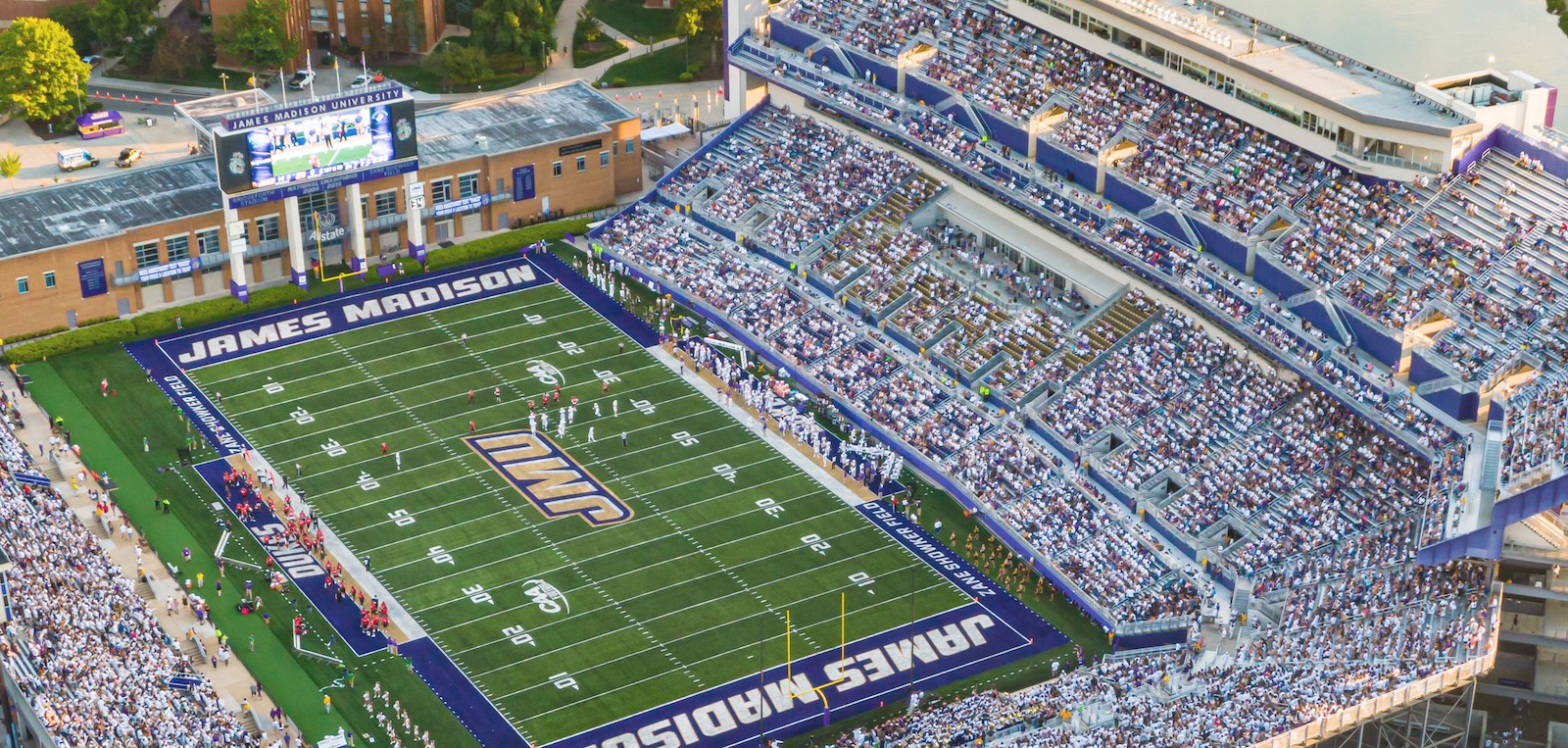
The Missouri Valley Conference would like to add at least one member to get back to an even number, according to Commissioner Jeff Jackson. He was asked about the conference’s plans regarding realignment in the wake of James Madison leaving for the American and the potential dominoes. Jackson was also asked about the rumor of the MVC potentially adding Kansas City, Omaha, and/or St. Thomas (MN) as a full member.
“We’re pretty fortunate. The 11 members that we have, and I think most people understand, is we’re geographically sensible. I think our schools feel that the Missouri Valley Conference serves them well. I think when you look at how we’re assessed nationally, whether it’s in basketball, whether it’s in baseball, whether it’s in soccer, whether it’s in volleyball, I think we can point to being a conference of prominence. But I think I would be disingenuous or remiss not to say that we do have an interest in getting to an even number. I think an opportunity to get to an even number provides us logistically… I’ll give the example of basketball.
So, as most people know, we have a great relationship with CBS and ESPN, and part of that relationship is we end our season a week early. We play on the first Sunday [of Championship Week]. Well, when we have an odd number when it comes to how many teams are playing in our basketball, that also costs us another week because we have to account for two byes. So, the way that we look at it in scheduling parlance, when we have an even number, we can use 20 windows in order to complete our schedule. When we have an odd number, we need 22 windows. So when you’re looking at it from just the sport of basketball by having an odd number, we almost lose two weeks of our season. We lose a week because of when we play our championship, but then we lose another week because we have to account for those byes.
So, I think as we are trying to put ourselves in the best position to be successful in basketball, we want our coaches, we want our institutions to have as much grace, as much flexibility in the non-conference slate as we can possibly give them. Getting to an even number affords us that ability. And I think you couple with, we certainly would like to see more depth when it comes to a sport like men’s soccer, or baseball, or even football for that matter. I think right now we’re having a lot more true conversations about trying to figure out if there’s a school that can help us get to an even number and ease some of the strain that we have logistically.”
(On the Kansas City/Omaha/St. Thomas rumors)… “Look, we would never ever talk about what schools we’re having conversations with. The only time that we’re going to talk about something like that is if we’re extending an invitation. What I would say is that the Valley for a lot of folks is an aspirational conference. The Valley is a stable conference. The Valley has really strong leadership in the boardroom. And I think there may be institutions that look at us as an opportunity and I think we’re going to spend the next couple months of trying to figure out if that is indeed the case. I think the one thing that people should keep in mind is that as much as we understand the advantages of managing things in a much more…easier fashion if we’re at an even number. It is just solving a math problem, and we’ve been able to solve that math problem for the last couple of years. So, it’s not something that we have to, but I think if the right institutions came across that would afford us an opportunity to get to an even number and manage some of the things we’re looking at in a more efficient fashion, I think our board will give that great consideration.”
(On whether it’s a specific number like 12 or 14)… “No, I think the term is even number. I think an even number, especially, again as I talked about how we look at our basketball scheduling. The advantages of being one of the first out and just easing that strain in terms of how we’re looking at things immediately comes to mind.”
NCAA Looking to Hike Application Fee
The NCAA Division 1 Membership Committee recommends that the Board of Directors increase the application fee for new schools. The latest fee was $1.96 million, and the new recommendation is to set the “application fee to be six times the amount of the estimated annual average value of direct benefits through distribution and champions made available to Division I members.” The amount will change year-to-year. If adopted, the increased fee would go into effect on January 20, 2027, for schools joining D1 in the 2027-28 academic year or later.
This recommendation reflects the committee’s conclusion that the current application fee undervalues Division I membership. The increased application fee is based on the fewest number of years that a reclassifying institution needs to move from entering the reclassification process to becoming fully eligible to receive DI revenue distribution. It more accurately reflects the value of Division I membership, retains the legislation’s existing refund provisions, mitigates the dilution of revenue distribution for members of the division and helps positions the division to address any championships-related pressures a larger division may face. Further, the increased application fee helps a reclassifying institution demonstrate its financial commitment to Division I’s philosophy, operating principles and student-athlete experience.
Sun Belt Raises Exit Fees
The Sun Belt Conference has raised its exit fees, according to Ross Dellenger. The conference will now have a range of $8 to $18 million, up from $5 million. Schools that provide a 27-month (or longer) notice will have an $8 million exit fee, while shorter notices will increase the fee. Of course, schools and conferences can always negotiate the fees or resort to the courts to settle any disagreements. The expected increase in exit fees was one of the reasons why James Madison left for the American. JMU could join the American as soon as July 1, 2027.
Two Championships to Change Seeding
The NCAA announced that men’s soccer and women’s field hockey will start seeding half the bracket beginning with the 2026-27 academic year. The change will result in 24 seeded teams for men’s soccer (previously 16) and 8 teams in women’s field hockey (previously 4). The expanded seeding will provide greater competitive balance and prioritize matchups based on strength of teams, according to the NCAA.
NCAA Division 2 News
D2 Championship Enhancements
The NCAA Division 2 Management Council approved $4.2 million to help improve championships for the 2027-28 through 2029-30 academic years. The recommendations were made by the Championships Committee in September and include:
- Eliminate altitude conversions for men’s and women’s track and field
- Expand men’s soccer bracket by 4 teams
- Increase men’s wrestling qualifiers for finals by 20 wrestlers
- Increase men’s wrestling super regionals from 1 to 2 days
- Expand men’s and women’s basketball dates to 3 weekends
- Increase men’s and women’s indoor track and field from 2 to 3 days and increase field sizes from 18 to 20 for individual events
- Increase men’s and women’s outdoor track and field to 22 participants for combined events
- Bracket by super regionals in women’s soccer, similar to men’s soccer
The Management Council also noted that the women’s rowing Championship will continue to be evaluated. Only 7 of the 14 women’s rowing programs at D2 meet the requirements for championship selection, which does not align with the access ratios of the division. The Council also approved the in-region non-conference opponent policy requiring teams to play at least one in-region non-conference opponent for all team sports, except football. For football, it has to be a non-conference team, and it can be an out-of-region opponent. These policies will take effect with the 2027-28 academic year.
GLIAC Looking to Expand?
Ferris State University Athletic Director, Steve Brockelbank, briefly spoke about the Great Lakes Intercollegiate Athletic Conference (GLIAC) meetings in an AD update video. The GLIAC has 11 members located in Illinois, Indiana, Michigan, and Wisconsin. The most recent membership change was Roosevelt joining in 2023 from the NAIA. The most recent departures have been to the Great Midwest Athletic Conference (G-MAC), with 9 members leaving for the G-MAC since 2016. Brockelbank stated at the end of the video:
“We just came back from a conference meeting, and I know the GLIAC is always working hard in search of additional conference membership, and we’re excited about that. We’re always in search of football scheduling alignments with people. I know our conference commissioner is working hard on that. Lots of activity going on at the confernece level that could be positive for Ferris State.”
He also expressed support for the D2 basketball tournament proposal that would change the tournament from 8 eight-team regions to 16 four-team regions. The proposal would also rank the top 8 NPI seeds so they wouldn’t meet prior to the quarterfinals. That proposal will be voted on at the NCAA Convention in January 2027.
Gulf South Officially Dropping Football
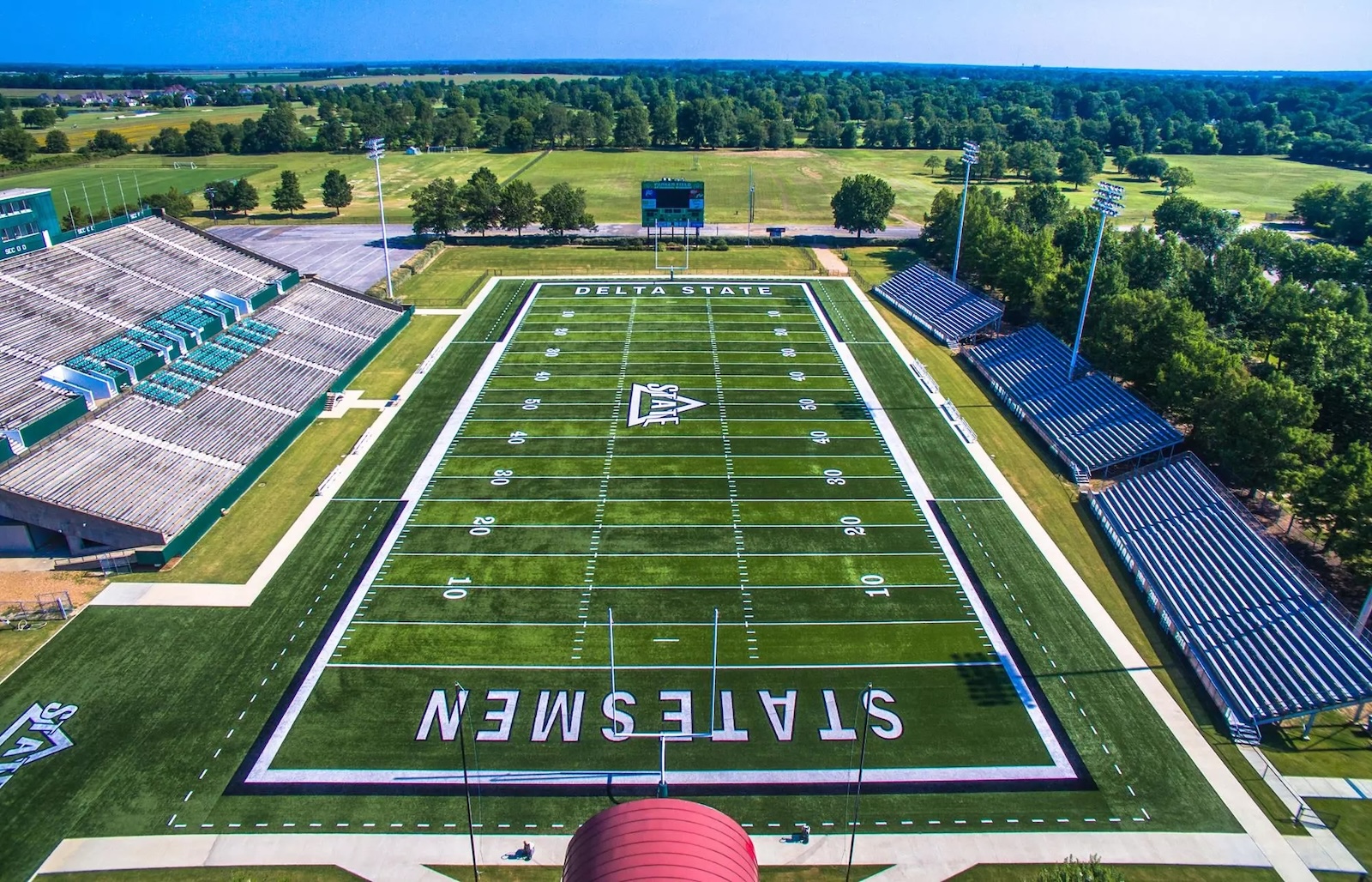
The Gulf South Conference will no longer sponsor football after the 2026-27 academic year, as confirmed by Delta State. The news is no surprise given recent events and the current state of the GSC football membership. Delta State, Valdosta State, and West Alabama are the three remaining football members for the 2026 season. However, Valdosta State already announced it will move to the Peach Belt Conference at the start of the 2027-28 academic year, with football competing as an independent. Delta State’s announcement also confirmed that West Alabama will compete as an independent.
Delta State held a press conference to address some of the questions about the program and the school’s athletic future. President Dan Ennis said that the school is not planning to move to Division 1 because the $5.9 million in athletic spending is already below the D2 median of $6.5 million and over three times lower than the FCS average ($17 million). The school doesn’t plan to move down to D3 because the savings in athletics would be offset by a decrease in alumni and fundraising support.
The school also noted that the Southern Intercollegiate Athletic Conference (SIAC) is not seeking new members and Delta State is not interested in joining. The Great American Conference (GAC) is also not interested in a football affiliate agreement, despite repeated overtures from Delta State and plans to continue pursuing such an agreement. Delta State is hopeful that the recent D2 change requiring football teams to play a non-conference opponent will allow them to play more GAC opponents and fulfill that requirement. Ennis hinted at scheduling games with the Great Lakes Valley Conference (GLVC) and Mid-America Intercollegiate Athletic Association (MIAA). Delta State and West Alabama will continue playing annually.
Ennis said the ultimate goal is to remain a full member of the Gulf South Conference and secure a 3-to-7-year scheduling agreement with another conference that allows Delta State to play an entire conference during that time. Delta State can only qualify for the D2 Football Playoffs as an at-large team, which requires a highly rated strength of schedule. DSU also wants to avoid money games and too many road games. During the Q&A session, Ennis addressed the possibility of starting a conference, noting he hadn’t thought of the possibility, but would consider the idea if a new conference was created.
The deterioration of the Gulf South football sponsorship was rapid, with all 9 members leaving within 3 years. During the 2023 season, the Gulf South boasted Chowan, Delta State, Mississippi College, North Greenville, Shorter, Valdosta State, West Alabama, West Florida, and West Georgia as members. Before the 2024 season, Erskine joined, but it was offset by Shorter leaving for D2 football independence and West Georgia leaving for NCAA Division 1. In 2025, Chowan, Erskine, and North Greenville left for the resurrected football sponsorship in Conference Carolinas, while Mississippi College dropped football completely. That left Delta State, Valdosta State, West Alabama, and West Florida. The GSC received a waiver for its football Automatic Qualification bid to the D2 Football Playoffs for 2025, but it was denied for the 2026 season.
NCAA Division 3 News
CUNYAC Will Become CITY Collegiate Conference
The City University of New York Athletic Conference (CUNYAC) will become the CITY Collegiate Conference beginning with the 2027-28 academic year. In April 2025, the CUNYAC announced a new conference would be formed, but did not disclose a name. Baruch College, Brooklyn College, City College of New York, Hunter College, John Jay College, Lehman College, Medgar Evers College, Pratt Institute, Saint Elizabeth University, and York College will be the inaugural 10 members moving over from the CUNYAC. All schools are located within New York City, except for Saint Elizabeth, which is located in Morristown, New Jersey.
Management Council Opposes Eligibility Model, Presidents Council Takes No Position
The NCAA Division 3 Management Council recommended that the D3 Presidents Council oppose the proposed age-based eligibility model. The proposal is similar to the NCAA Divisions 1 and 2 models, with athletes having up to five years of eligibility when the athlete enrolls full-time at the school or in the academic year that starts immediately after their 19th birthday, whichever occurs first. Earlier in October, the D3 Membership Committee did not take a position on the model, citing the lack of time before the convention to understand the complexities of the proposal. The NCAA Division 3 Presidents Council took no position on the proposal.
Maryville Returning to CCS
Maryville College (Maryville, Tennessee) will leave the Southern Athletic Association (SAA) to rejoin the Collegiate Conference of the South (CCS) beginning with the 2027-28 academic year. Maryville was a founding member of the CCS from 2022-23 through 2025-26 before joining the SAA at the beginning of the 2026-27 academic year. The school noted affiliate memberships were being finalized for football and women’s golf, but did not mention three other sports: men’s and women’s indoor track & field and women’s STUNT. The CCS does not sponsor indoor track & field, according to the conference’s website. STUNT has competed as an independent while in the SAA and will presumably continue to do so.
The SAA is set to fall from 9 full members to 6 at the start of the 2027-28 academic year. Millsaps and Southwestern (TX) will also depart the SAA next year to join the Southern Collegiate Athletic Conference (SCAC). The SAA previously saw Birmingham-Southern close in 2024, and Hendrix leave for the SCAC in 2025. How the SAA leadership responds to the exodus remains to be seen. There have to be growing concerns among the membership, especially for Trinity (TX), which will be geographically isolated. Meanwhile, the CCS will grow to 8 full members, although Agnes Scott College does not sponsor men’s sports. The CCS has seen three departures: Berea in 2024 to the Heartland Collegiate Athletic Conference (HCAC), Maryville in 2026 to the SAA, and Wesleyan (GA) to the NAIA’s Southern States Athletic Conference (SSAC). A map showing the memberships of the CCS, SAA, and departing members is below.
North Central College to Change Name
North Central College will become North Central University Naperville beginning with the 2027-28 academic year. The school will maintain the Cardinals nickname and mascot. The school will continue to go by “North Central” and use the block NC logo.
Waiver Reconsiderations and Possible Changes to Minimum Sponsorship Changes
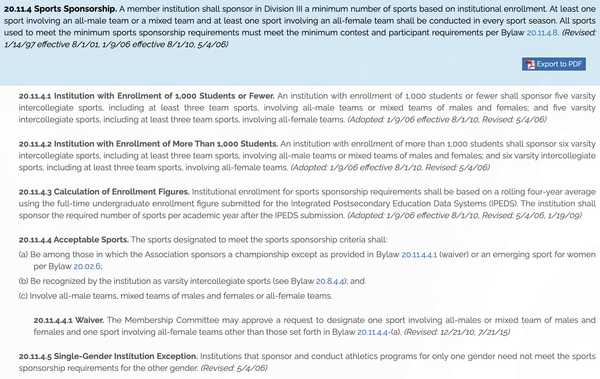
The NCAA Division 3 Membership Committee reconsidered two sports sponsorship waiver requests for the 2025-26 academic year. The Committee approved the Medgar Evers women’s soccer waiver, but denied Pratt Institute‘s request for men’s golf. The Committee said that Pratt provided “insufficient mitigation.” The Committee is also reviewing changes to Bylaw 20.11.4, which sets minimum sports sponsorship based on enrollment. Larger institutions will keep the current minimums (typically 6 sponsored sports), while adding new tiers for smaller schools. The Committee will continue to discuss the new minimums at the next meeting. The current bylaws are provided below.
NAIA News
Cal Pac Disbanding
The California Pacific Conference (Cal Pac) will disband at the end of the 2026-27 academic year. The Cal Pac has five full members: Northern New Mexico College, Pacific Union College, Simpson University, Stanton University, and Westcliff University. Simpson has already announced it will join the Cascade Collegiate Conference (CCC) beginning with the 2027-28 academic year. The other four institutions have not announced their new conference, but the Cal Pac press release states that all five remaining members “will remain in the NAIA and are assured membership in other conferences for 2027-28 and beyond.”
The Cal Pac’s demise has been extensively documented here for the last few years. Antelope Valley (closed), Benedictine-Mesa (GSAC), Embry-Riddle-Prescott (GSAC), Park-Gilbert (GSAC), and Saint Katherine (closed) left the Cal Pac effective with the 2024-25 academic year. At the start of the 2025-26 academic year, La Sierra (GSAC), Providence Christian (closed), Soka (GSAC), and UC Merced (D2 CCAA) departed. The Cal Pac added Northern New Mexico and Stanton at the start of the 2025-26 academic year, while Cal Maritime became a part-time member. Cal Maritime dropped athletics at the start of the 2026-27 academic year, leaving the Cal Pac with 5 members. In September, Simpson announced it would depart the Cal Pac, putting the conference’s future in serious doubt.
Georgia Highlands Exploring NAIA Move
Georgia Highlands College (Rome, Georgia) is exploring a move to the NAIA in the next two years, according to Athletic Director Nichole Levering. GHC currently competes in the NJCAA as a member of the Georgia Collegiate Athletic Association (GCAA). Levering cited the lack of schools competing outside basketball, with the school offering six sports: men’s baseball, men’s basketball, women’s cross country, women’s flag football, women’s softball, and women’s volleyball. One possible future sport would be men’s cross country. When Georgia Highlands eventually joins the NAIA, there are several conference options for the school based in Northern Georgia: the Appalachian Athletic Conference, the Mid-South Conference, and the Southern States Athletic Conference (SSAC). The school could also compete in the Continental Athletic Conference, which is made up of independent NAIA programs.
NAIA 5-Year Eligibility Proposal
The NAIA held a Town Hall to discuss the upcoming vote on the five-year eligibility model. The vote on whether to adopt the new model will be held on Wednesday, November 4. If adopted, the proposal would take effect beginning with the 2027-28 academic year. Based on the Town Hall, students who competed starting in the 2023-24 academic year or later will be eligible for a fifth season at the start of the 2027-28 academic year. The NAIA is basing the eligibility model on athletic eligibility without a clock model used by the NCAA. Some of the points worth noting about the proposed model include:
- 10 semesters or 15 quarters of attendance limit.
- 5 Seasons of Competition will be the maximum allowed.
- Eliminating the 20% rule for seasons of competition.
- Implement a “Progress Rule” for athletes going into the 5th season of competition based on certified credits (96 semester/144 quarter required, with 64 semester/96 quarter hours in general education and/or major).
- Evaluating transfers from a 4 or 5-year clock model (i.e., NCAA, NCCAA, USCAA) under the new NAIA eligibility model.
- Eliminating the medical hardship waiver.
- Transfers that competed in at least one contest would be charged with a full season of competition.
- Athletes who were previously under a 4-year model (i.e., NCAA Division 3) would not be allowed to compete for a 5th season in the NAIA’s new model.
- No age restrictions or clock rule will be imposed.
- If an NCAA athlete’s clock has run out, but they have remaining Terms of Attendance or Seasons of Competition under the NAIA bylaws, then they are eligible to transfer to an NAIA institution to compete for a fifth season.
- Athletes who have completed 4 seasons of athletic competition in a sport, such as those enrolling for the first time in the 2022-23 academic year, are not eligible to compete for a fifth season in 2027-28.
Opinion/Thoughts: It’s obvious that the NAIA saw the legal issues the NCAA faced and decided to avoid the same fate to the extent possible. The 9-to-10 month timeline for implementing this, while including athletes currently competing in the 2026-27 academic year, was smartly planned. Personally, I don’t like the exclusion of athletes who completed four years because it makes things a bit convoluted. Here’s the exact wording from the proposed bylaw under Article V, Section F:
Any student for whom any of the following conditions apply shall have no eligibility remaining in that sport within the NAIA:
a. Completed eligibility in an athletic association for four-year institutions;
Is an athlete who played in D3 at any point excluded? Or is it based on where the athlete played their final season of competition? An athlete who plays 3 years in D3, 1 year in D2, and then transfers to an NAIA school would be eligible for a 5th year under the new policy. It’s an edge-case scenario, but it invites legal questions about why the 3 years spent within D3 don’t matter compared to where the most recent season was played, whether it was within D3, NCCAA, or USCAA (if that’s the correct interpretation).
There’s another way to interpret that bylaw: Any time spent within D3 means a player has a maximum of four seasons, regardless of where the final season is played. Based on this specific interpretation, a player who plays 1 year in D3, 3 years in D2, and then transfers to an NAIA school may not be eligible. It certainly sounds like a legal argument could be made against the transfer because they technically completed eligibility in NCAA Division 3. Furthermore, couldn’t that be extrapolated to D1 and D2 athletes? If they played 4 years and can’t compete in D3 if it remains under a 4-year model, this means the athlete completed eligibility in an athletic association for four-year institutions. I don’t believe that to be the intention of the rule, and I don’t think we’re likely to see too many NCAA athletes looking to move to NAIA schools just for a fifth year. However, a 5-year eligibility model applied to all NCAA Divisions and other four-year governing bodies (NCCAA and USCAA) would make things a whole lot simpler.
Providence Closing
The University of Providence (Great Falls, Montana) will close at the end of the 2026-27 academic year, citing lower enrollment and higher costs. Providence is a full member of the Frontier Conference. 12 of the school’s 16 varsity teams compete in the Frontier, while men’s and women’s soccer and wrestling compete in the Cascade Collegiate Conference (CCC). The school also has a men’s hockey program that competes in the Mountain West Collegiate Hockey League (MWCHL) of the American Collegiate Hockey Association (ACHA).
The Frontier will have 11 full members going at the start of the 2027-28 academic year, assuming no additional changes. Providence is one of more than 30 schools to drop their athletics program, merge with another institution, or close since the start of the 2025-26 academic year. The full list of athletic departments that have been closed can be found below the map.
| School | Affiliation | Conference | Status (Internal Link) | Effective Year |
|---|---|---|---|---|
| Academy of Art | NCAA Division 2 | Pacific West | Dropped Athletics | 2025-26 |
| Anna Maria | NCAA Division 3 | MASCAC | Closed | 2026-27 |
| Bryn Athyn | NCAA Division 3 | United East | Dropped Athletics | 2025-26 |
| Cal Maritime | NAIA | Cal Pac | Merging with Cal Poly, Dropped Athletics | 2026-27 |
| College of Alameda (CA) | 3C2A | Bay Valley | Dropped Athletics | 2026-27 |
| Concordia Ann Arbor | NAIA | WHAC | Dropped Athletics | 2025-26 |
| Crestmont (CA/SD) | Unaffiliated | Independent | Dropped Athletics | 2026-27 |
| Fontbonne | NCAA Division 3 | SLIAC | Closed | 2025-26 |
| Hampshire College (MA) | USCAA | Independent | Closed | 2026-27 |
| Limestone | NCAA Division 2 | South Atlantic | Closed | 2025-26 |
| Lourdes | NAIA | WHAC | Closed | 2026-27 |
| Miami Middletown (OH) | USCAA | Independent | Merging Sports with Miami Hamilton | 2027-28 |
| Multnomah | NAIA | Cascade | Merged with Jessup, Dropped Athletics | 2025-26 |
| New Jersey City | NCAA Division 3 | NJAC | Merged with Kean, Dropped Athletics | 2026-27 |
| Northland College | NCAA Division 3 | UMAC | Closed | 2025-26 |
| Oakland City (IN) | NAIA | River States | Dropped Athletics* (May Return in 2027-28) | 2026-27 |
| Penn State DuBois | USCAA | PSUAC | Closing | 2027-28 |
| Penn State Fayette | USCAA | PSUAC | Closing | 2027-28 |
| Penn State Mont Alto | USCAA | PSUAC | Closing | 2027-28 |
| Penn State New Kensington | USCAA | PSUAC | Closing | 2027-28 |
| Penn State Shenango | USCAA | PSUAC | Closing | 2027-28 |
| Penn State Wilkes-Barre | USCAA | PSUAC | Dropped Athletics, Closing in 2027-28 | 2025-26 |
| Penn State York | USCAA | PSUAC | Closing | 2027-28 |
| Providence (MT) | NAIA | Frontier | Closing | 2027-28 |
| Providence Christian | NAIA | Cal Pac | Closed | 2025-26 |
| Rosemont College | NCAA Division 3 | United East | Merged with Villanova, Dropped Varsity Athletics | 2026-27 |
| SCAD Atlanta SCAD Savannah | NAIA | Appalachian Sun | Merging Athletic Departments | 2026-27 |
| Siena Heights | NAIA | WHAC | Closed | 2026-27 |
| Southwest Virginia CC | NJCAA | Region 10 | Dropped Athletics | 2026-27 |
| St. Andrews | NAIA | Appalachian | Closed | 2025-26 |
| Trinity Christian (IL) | NAIA | Chicagoland | Closed | 2026-27 |
| UHSP | NAIA | American Midwest | Acquired by WashU, Dropping Athletics | 2027-28 |
| Valley Forge | NCAA Division 3 | United East | Dropped Athletics | 2026-27 |
Photo Credit to Delta State University Athletics